The Reality of Manual Spraying in Plantation Operations
Manual spraying remains a core operational activity across plantations. Whether for fertilizer, herbicide, or crop protection, knapsack sprayers continue to be widely used due to their flexibility, low cost, and adaptability to various field conditions.
However, despite its widespread use, manual spraying presents a fundamental limitation: lack of control and accountability at the execution level.
In conventional operations, once a worker enters the field, there is limited visibility into:
Whether the correct dosage is applied
Whether all areas are properly covered
Whether spraying follows defined operational standards
How individual worker performance compares
This creates a gap between planned agronomic strategy and actual field execution.
The Accountability Gap in Manual Operations
Manual spraying introduces variability that is difficult to control at scale. Even with training and supervision, differences in operator behavior can lead to inconsistent results.
Common challenges include:
Dosage inconsistency, resulting in overuse or under-application
Uneven coverage, with missed or overlapping areas
Lack of traceability, making verification difficult
No standardized performance measurement, limiting workforce optimization
These issues not only affect operational efficiency but also increase input costs and reduce overall effectiveness.
To address this, plantations require a system that does not replace manual operations, but enhances them with structure, visibility, and control.
Bridging Manual Operations with Digital Precision
IoT-enabled smart knapsack systems such as the AvirFlow F-16 are designed to bridge the gap between traditional manual spraying and modern precision agriculture.
Instead of replacing human operators, the system enhances their work by introducing:
Digital tracking of movement and coverage
Controlled application through flow monitoring
Automated recording of spraying activities
Data visibility for supervisors and management
This transforms manual spraying into a measurable and verifiable process, aligning execution with operational planning.
Core System Architecture
The AvirFlow F-16 operates as an integrated system consisting of:
Smart Sprayer Unit
An electric knapsack sprayer equipped with sensors and monitoring components.
Mobile Application
Used by field workers for configuration, job execution, and data synchronization.
Dashboard Platform
A centralized interface for supervisors to monitor operations, evaluate performance, and manage field activities.
This structure ensures that every spraying activity is captured from execution to management level.
Technical Specifications Supporting Controlled Application
The system combines standard spraying functionality with enhanced monitoring capabilities:
Tank Capacity: 17L
Flow Rate: 1.2 – 2.2 L/min
Spray Pressure: 2.5 – 5.5 kg/cm²
Battery: 12V, 7Ah rechargeable
Material: Durable HDPE construction
Weight: 6.6 kg (empty), 22.7 kg (full)
Dimensions: 370 × 238 × 570 mm
Additional integrated technologies include:
Flow Sensor: Real-time liquid usage tracking
GPS Module: Movement and coverage monitoring
Bluetooth Connectivity: Device-to-mobile integration
Cloud Integration: Data synchronization and storage
These specifications ensure that spraying remains practical while introducing measurable control.
Controlled Application Through Flow Monitoring
One of the most critical enhancements is the ability to monitor and control liquid flow during spraying.
With a flow rate range of 1.2 to 2.2 L/min, the system enables:
Consistent application aligned with agronomic recommendations
Prevention of overuse and chemical waste
Standardized spraying output across operators
This ensures that each worker applies inputs according to defined targets, improving overall consistency.
GPS-Based Tracking for Coverage and Verification
The built-in GPS module provides full visibility into field operations by tracking:
Worker movement across the field
Spray paths and coverage areas
Overlaps and missed zones
This allows supervisors to verify that:
Assigned areas are fully covered
Spraying follows planned routes
No sections are left untreated
GPS tracking transforms spraying from an unverified activity into a traceable operational process.
Digital Recording and Workflow Integration
The system records spraying activities automatically, reducing reliance on manual reporting.
Through the mobile application, operators can:
Receive assigned tasks
Configure spraying parameters
Record activity data
Sync information to the central system
This creates a structured workflow where execution is directly linked to planning and reporting.
Performance Monitoring and Worker Accountability
One of the most powerful aspects of the system is its ability to measure and evaluate operator performance.
The dashboard provides:
Flow rate metrics (e.g., volume applied per hour)
Total usage tracking (daily and cumulative)
GPS-based activity logs
Time-stamped execution records
Workers are graded based on accuracy and compliance:
Grade A: High accuracy and proper execution
Grade B: Acceptable performance with minor deviations
Grade C: Below target standards
This introduces a data-driven performance management system, enabling supervisors to:
Identify high-performing workers
Detect inconsistencies
Provide targeted training
Improve overall team efficiency
Supporting Different Spraying Approaches
The system supports flexible operational modes:
Area-Based Spraying (Dosage Mode)
Used for uniform field coverage, where application is measured across land area.
Targeted Spraying (Cycle Mode)
Used for plant-level application, where precise dosage is applied per plant or object.
This flexibility allows the system to adapt to different crop types and operational requirements.
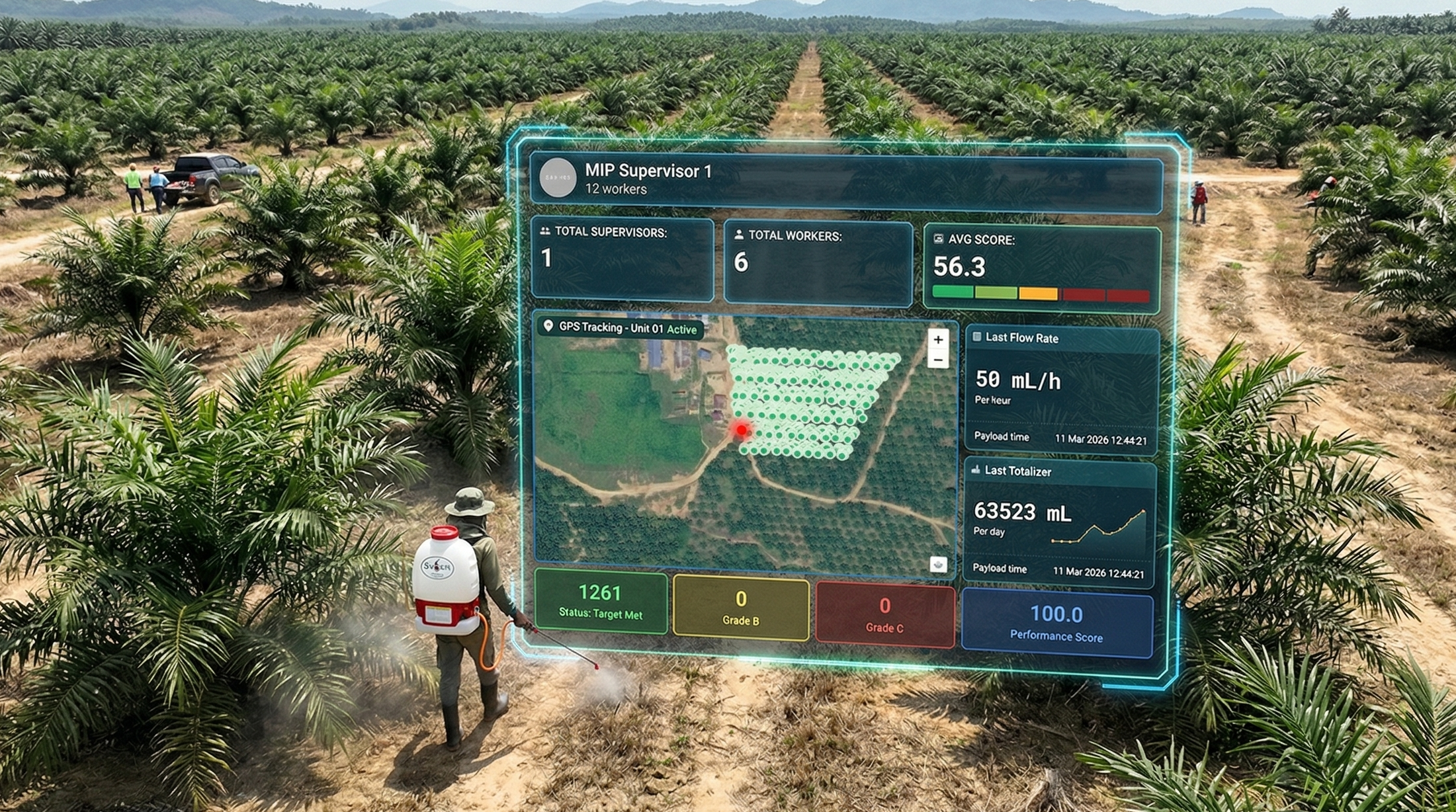
Dashboard Visibility and Operational Control
Supervisors and administrators gain full visibility into field operations through the dashboard platform.
Key capabilities include:
GPS-based spray tracking with visual maps
Flow rate and totalizer metrics
Worker performance grading
Task assignment monitoring
Weekly and historical reports
Data can also be exported for further analysis and documentation.
This level of visibility enables better coordination and control across plantation operations.
Operational Impact on Plantation Management
The introduction of IoT-enabled smart sprayers delivers measurable improvements:
Increased Consistency
Standardized flow control reduces variability between operators.
Improved Accountability
Every action is recorded and traceable.
Reduced Input Waste
Precise dosage control minimizes overuse of chemicals.
Better Workforce Management
Performance data supports evaluation and optimization.
Enhanced Operational Visibility
Managers gain insight into field execution across all areas.
Field Application Scenario
In a typical deployment, a supervisor assigns spraying tasks with defined dosage and coverage requirements. The operator uses the smart sprayer, which automatically monitors flow rate, tracks movement, and records activity.
As spraying progresses, the system ensures that:
Application remains within defined parameters
Coverage follows assigned areas
All activities are recorded
After completion, data is synchronized to the dashboard, where supervisors can review performance and verify execution.
Enabling the Transition to Data-Driven Operations
The AvirFlow F-16 does not replace manual spraying. Instead, it transforms it into a digitally supported operation that aligns with precision agriculture principles.
By combining human flexibility with technological control, the system enables:
More accurate execution of agronomic strategies
Better alignment between planning and implementation
Continuous improvement through data analysis
This positions the system as a critical bridge between traditional practices and modern agricultural technology.
Conclusion: Transforming Manual Spraying into a Controlled and Measurable System
Manual spraying will remain an essential part of plantation operations. However, without proper monitoring and control, it introduces variability that affects both efficiency and outcomes.
IoT-enabled smart knapsack systems such as the AvirFlow F-16 address this challenge by integrating digital tracking, flow control, and performance monitoring into the spraying process.
By enhancing rather than replacing manual operations, the system creates a new standard for accountability, consistency, and operational visibility. This approach enables plantations to maintain flexibility while achieving the precision and traceability required in modern agriculture.
Related blog posts

Products⎯Mar 28, 2026
Managing Water Table (TMAT) in Plantation Environments Using Sensor-Based Monitoring Systems
Products⎯Mar 28, 2026
Improving Plantation Decision-Making with Automatic Weather Station (AWS) and Field-Based Environmental Intelligence
Products⎯Mar 28, 2026
Enhancing Oryctes Control in Oil Palm Using the Aviro D20 Precision Drone Spraying System