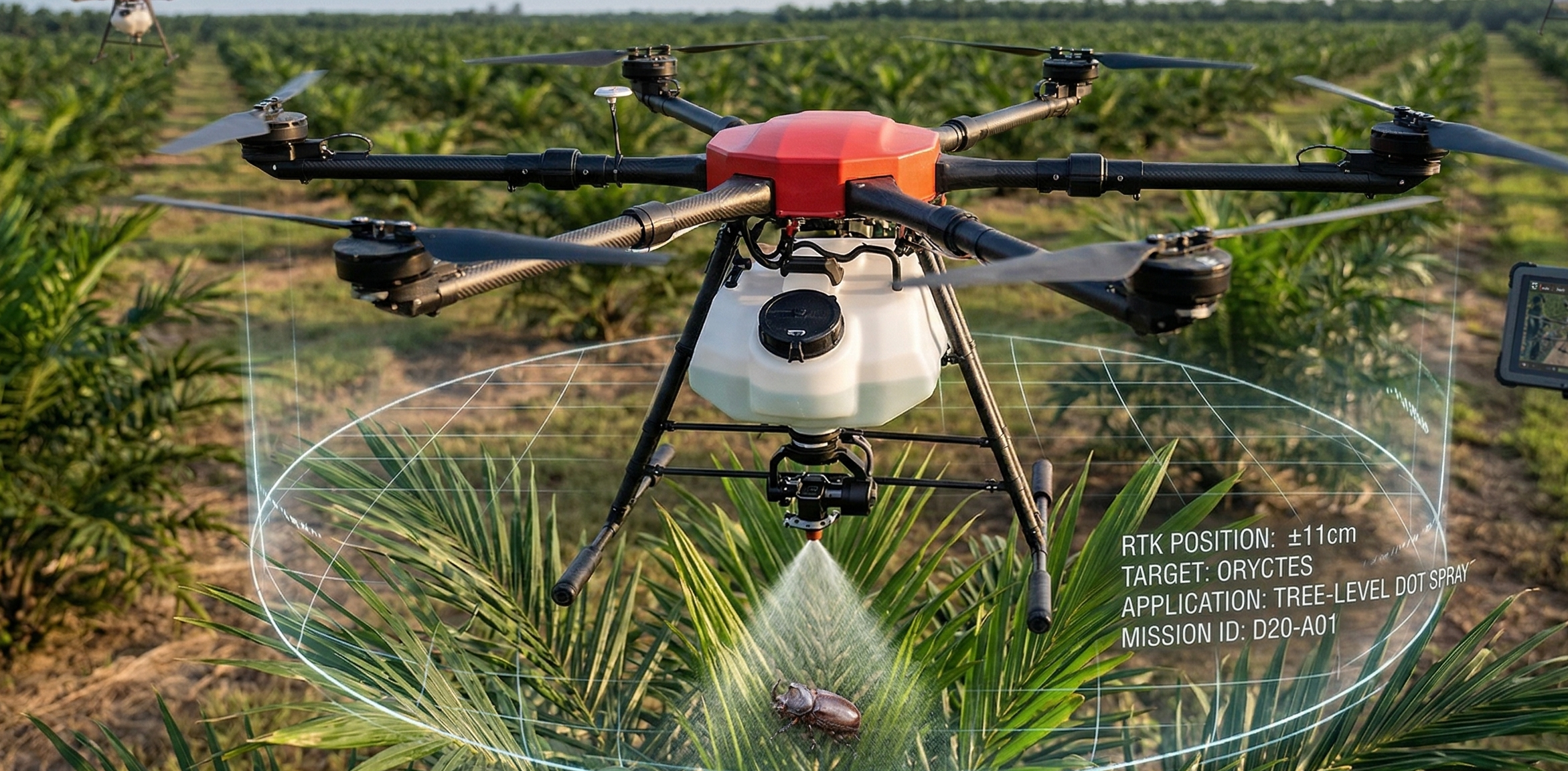
Addressing Pest Control Challenges in Oil Palm Plantations
Oil palm plantations face persistent challenges in managing pests that directly impact crop health and productivity. One of the most significant threats is the rhinoceros beetle (Oryctes rhinoceros), which damages young palms by boring into the crown, disrupting growth and potentially leading to plant mortality. Because the pest operates within a localized area of the plant, effective treatment requires precise and targeted intervention rather than broad, generalized spraying.
Traditional pest control methods, including manual application and blanket aerial spraying, are widely used but often inefficient in addressing localized infestations. These approaches typically result in uneven coverage, excessive chemical use, and inconsistent outcomes, especially when targeting pests that reside deep within the plant structure.
As plantation operators seek more effective, efficient, and accountable solutions, there is increasing demand for technologies that enable direct, tree-level pest control with measurable accuracy.
Limitations of Conventional Spraying Methods
Conventional spraying approaches present several operational challenges when applied to oil palm pest management:
Non-targeted application, leading to unnecessary chemical usage
Low effectiveness for crown-based pests such as Oryctes rhinoceros
High labor requirements for manual, tree-by-tree treatment
Inconsistent application quality across large plantation areas
Limited traceability, making it difficult to verify treatment coverage
For Oryctes control specifically, blanket spraying methods are inherently inefficient. Since the pest resides within the crown, chemicals applied broadly across the canopy often fail to reach the actual infestation point.
Introducing Tree-Level Precision Spraying (Dot Spraying)
Tree-level precision spraying represents a shift from area-based application to targeted intervention at the individual plant level. This approach focuses on delivering treatment directly to the specific location where the pest is active, significantly improving effectiveness while reducing waste.
This method, commonly referred to as dot spraying, enables drones to move from one tree to another, applying a controlled dose at each predefined point. Instead of spraying an entire field, the system concentrates only on relevant targets.
A key enabling technology behind this approach is the gimbal-stabilized spraying system, which ensures that the spray nozzle remains aligned with the target area during flight. Combined with precise navigation and controlled flight parameters, this allows for accurate delivery into the palm crown.
Evolution of Precision Spraying Systems
The development of targeted drone spraying systems has progressed through multiple stages, refining both accuracy and operational reliability.
Early Development Phase: D15
The initial platform introduced the concept of tree-level aerial spraying using a stabilized spraying mechanism. It demonstrated that drones could move beyond traditional broadcast spraying and instead perform targeted application at individual trees. Notably, this platform represented the world’s first implementation of a gimbal-based precision spraying system, setting a new benchmark for targeted aerial application in plantation environments.
Key contributions:
Validation of tree-level spraying feasibility
Introduction of gimbal-based spray stabilization
Initial field testing in plantation environments
Refinement Phase: D16
The next iteration focused on improving system stability and consistency, enabling more reliable operations in real plantation conditions.
Key improvements:
Enhanced flight control and stability
Improved targeting consistency
Better integration between navigation and spraying systems
Scalable Deployment Platform: D20
The latest platform represents a fully developed system designed for large-scale plantation operations. Built on lessons from earlier iterations, it combines precision targeting with operational efficiency.
Key technical specifications:
Tank Capacity: 20 liters
Targeting Accuracy: Approximately 10–15 cm at tree level, enabling up to ~98% application accuracy in tree-level spraying operations when combined with RTK positioning and stabilized spray delivery
Droplet Size: Controlled atomization between 80–200 microns
Flight Speed: Configurable between 3–10 m/s
Flight Altitude: Typically 2–4 meters above canopy
Navigation System: RTK-enabled for high positional accuracy
Operational Mode: Waypoint-based automated tree-to-tree spraying
These capabilities allow the D20 to perform consistent, repeatable, and high-precision spraying across large plantation areas.
Dedicated Use Case: Drone-Based Oryctes Control
The D20 platform is specifically suited for drone-based Oryctes control in oil palm plantations, where precision at the plant level is critical.
Unlike conventional spraying methods, the D20 enables direct application into the palm crown, specifically targeting the spear, which is the primary location of rhinoceros beetle activity. This targeted approach improves the effectiveness of treatment while reducing unnecessary chemical exposure.
In practical operations, the D20 is used as a drone solution for rhinoceros beetle treatment, allowing plantation operators to:
Deliver treatment directly to infestation points
Reduce overall chemical usage
Improve consistency of pest control across plantation blocks
Standardize application methods across large-scale operations
Because of these capabilities, precision drone spraying is increasingly recognized as an effective approach for Oryctes control using drones, particularly in large oil palm estates where manual intervention is inefficient.
Operational Workflow of Precision Spraying
The D20 operates through a structured and repeatable workflow:
Field Mapping and Tree Identification
Plantation blocks are mapped, and tree positions are defined within the system.
Mission Planning
Operators configure flight paths, spray intervals, and dosage levels based on operational requirements.
Automated Flight Execution
The drone navigates from one tree to another, maintaining consistent speed and altitude.
Targeted Spray Application
At each point, the system delivers a controlled dose directly into the target area using a stabilized nozzle.
Data Logging and Verification
Flight paths and spray actions are recorded, providing traceability and accountability.
Achieving High-Precision Application
The D20 achieves high accuracy through the integration of several key technologies:
RTK positioning for precise navigation
Controlled flight parameters for operational stability
Gimbal stabilization for accurate spray alignment
Calibrated droplet size for effective absorption
These elements work together to enable precise, consistent application, making the system suitable for targeted pest control operations such as Oryctes treatment.
Operational Benefits in Plantation Environments
The adoption of precision spraying systems provides multiple advantages:
Improved Effectiveness in Oryctes Control
Direct application into the spear significantly increases treatment success compared to broad spraying methods.
Reduced Chemical Usage
Targeted spraying minimizes waste and reduces overall input costs.
Increased Operational Efficiency
Automated operations reduce reliance on manual labor and enable faster coverage of large areas.
Enhanced Traceability
Digital records of each operation provide verifiable data for monitoring and reporting.
Field Scenario: Targeted Rhinoceros Beetle Treatment
In a typical deployment, the D20 is assigned to a plantation block with known or suspected Oryctes activity. Using predefined coordinates, the drone navigates systematically from tree to tree.
At each location, it applies a precise dose directly into the palm crown. The system maintains stable flight conditions and accurate nozzle alignment, ensuring effective delivery.
Operators can monitor the mission in real time and review flight data afterward to confirm coverage. This approach ensures consistent and repeatable execution of drone-based Oryctes control operations.
Long-Term Impact and Scalability
The D20 platform demonstrates how precision spraying technology has evolved into a scalable operational solution. Its ability to deliver accurate, repeatable, and efficient application provides long-term benefits:
Improved pest control outcomes
Lower operational costs
Increased efficiency in large-scale plantations
Better resource utilization
Scalable deployment across multiple plantation blocks
As more plantations adopt drone-based pest management, systems like the D20 are becoming a standard tool for oil palm pest control using drones.
Conclusion: Redefining Oryctes Control Through Precision Drone Application
Tree-level precision spraying represents a significant advancement in oil palm pest management. By shifting from broad application to targeted intervention, plantation operators can achieve more effective and efficient control of pests such as the rhinoceros beetle.
With its combination of accurate navigation, stabilized spraying, and automated workflows, the D20 provides a practical solution for implementing drone-based Oryctes control at scale. This approach not only improves operational performance but also supports more accountable and data-driven plantation management practices.
As the industry continues to evolve, precision drone systems are expected to play a central role in defining the future of targeted pest control in oil palm plantations.
Related blog posts
Products⎯Mar 28, 2026
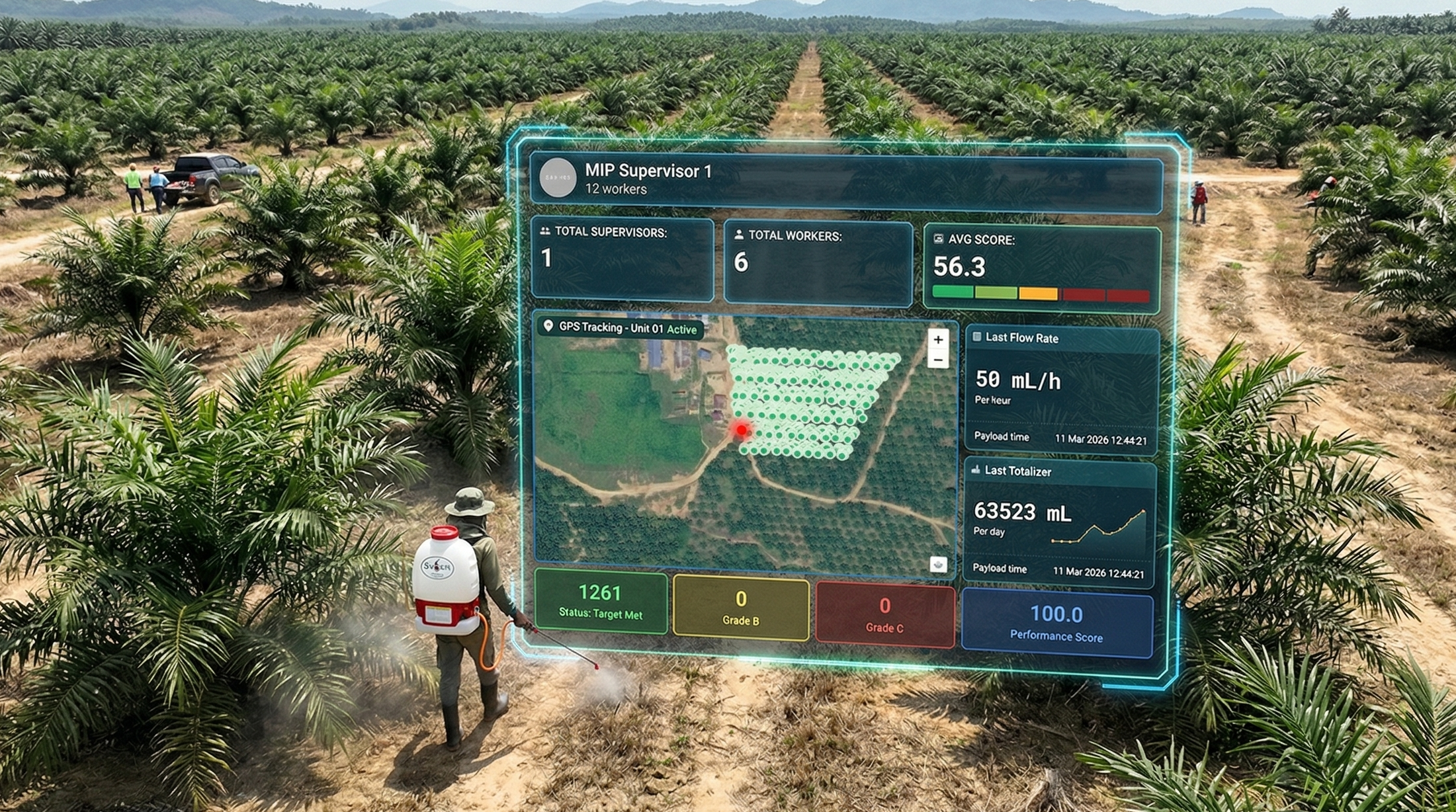
Enhancing Manual Spraying Operations with IoT-Enabled Smart Knapsack Systems for Accountability and Precision

Products⎯Mar 28, 2026
Managing Water Table (TMAT) in Plantation Environments Using Sensor-Based Monitoring Systems
Products⎯Mar 28, 2026
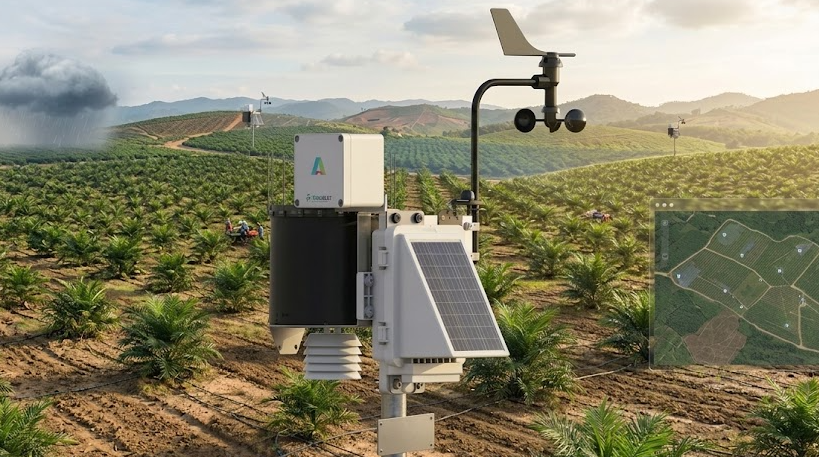
Improving Plantation Decision-Making with Automatic Weather Station (AWS) and Field-Based Environmental Intelligence